Flat or Concave Forehead? Why Shape Matters More Than Lines
When most people think about the forehead, they think about lines. The horizontal creases that appear when you raise your brows, the furrow between them, the surface that seems to crinkle more with each passing year. And so the assumption is usually that the answer is more anti-wrinkle treatment.
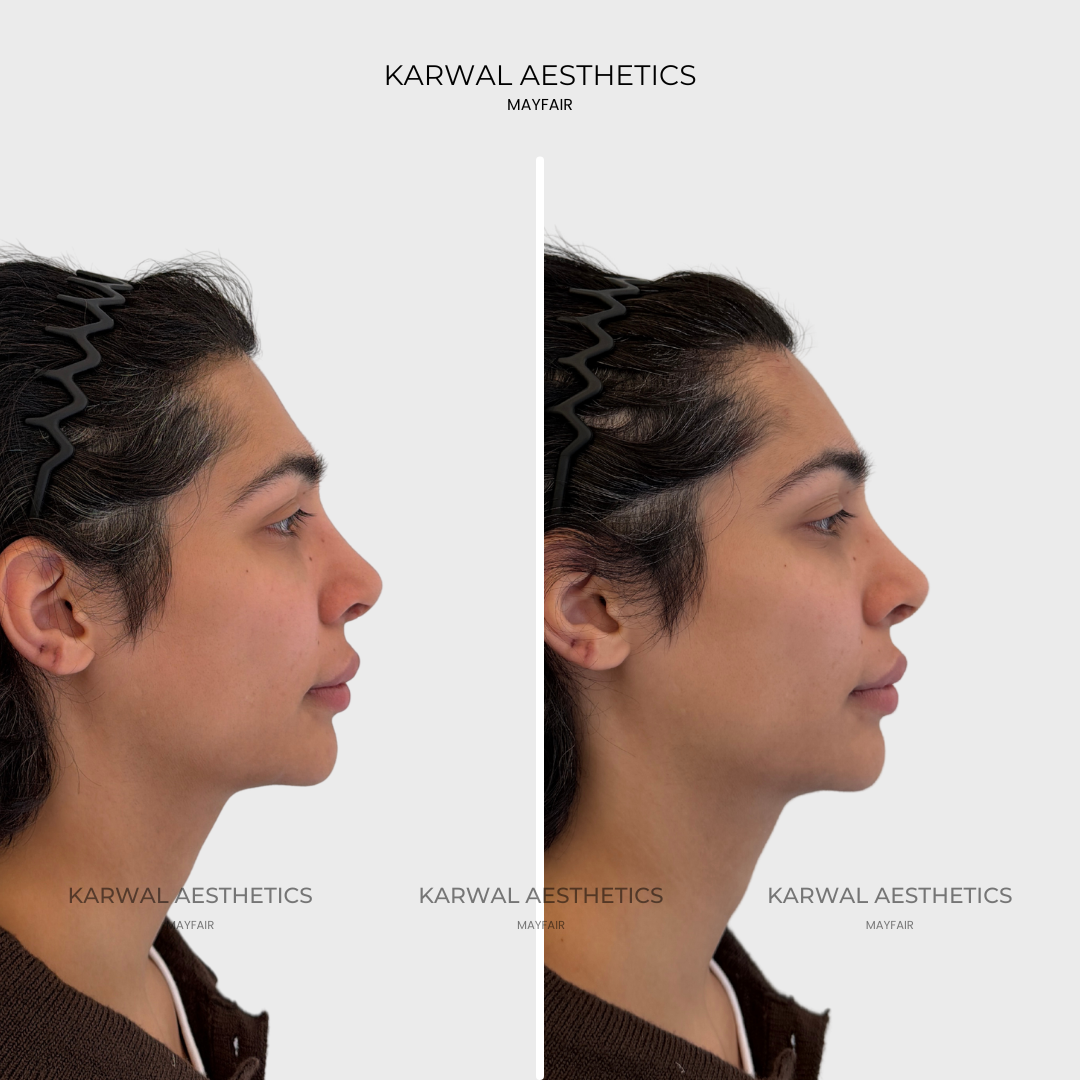
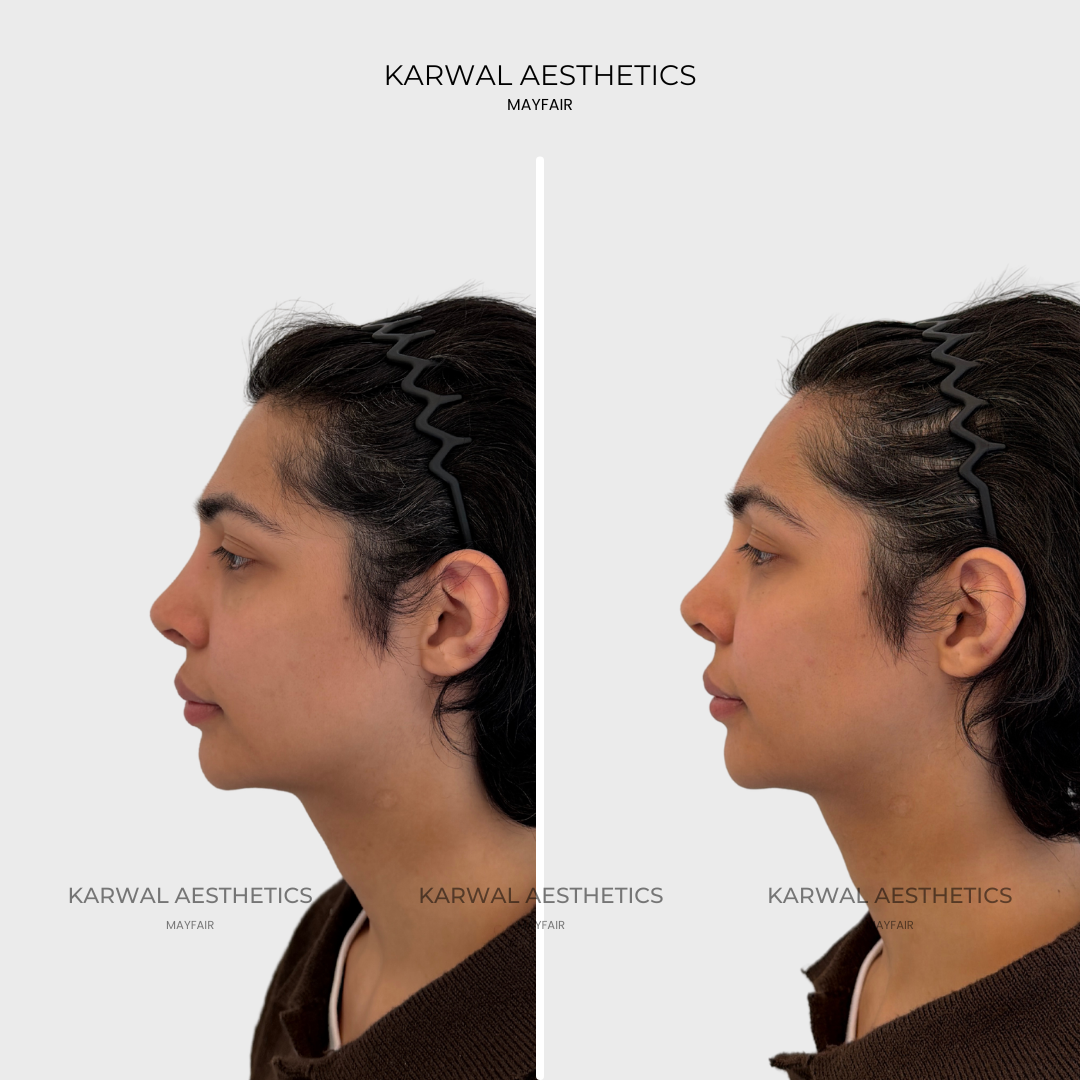
But a large number of the patients who come to us about their forehead are not really concerned with lines at all. They are concerned with shape. The forehead that lacks projection. The forehead that curves inward rather than outward. The surface that looks uneven, hollow, or irregular in a way that is difficult to describe but instantly felt every time they see a photograph taken from the side. These are structural concerns, and no amount of muscle-relaxing treatment will resolve them. They respond to one thing: precisely placed volume.
This is something we think is worth explaining properly, because it is so often overlooked.
The forehead is a third of your face
The forehead accounts for roughly a third of your face. It defines the upper portion of your profile, anchors the relationship between your brows and your hairline, and shapes how the entire face reads for proportion and balance. Yet it remains one of the most overlooked areas in aesthetics, and one of the most transformative when treated with precision.
The ideal forehead is not simply smooth or line-free. It has a natural convexity, a gentle outward curve that gives it projection when viewed in profile and a soft, rounded quality when viewed from the front. When that convexity is absent, or when the forehead curves inward instead of outward, the face can feel structurally off in a way that is hard to articulate but immediately visible.
A forehead that is too flat tends to make the face look less defined in profile. The transition from hairline to brow lacks the gentle arc that frames the upper face, and the nose and chin can appear more prominent by comparison. Not because they are too large, but because the upper face is not providing the counterbalance it should. A concave forehead is more pronounced still. The surface recedes, the brow ridge can look overly prominent, and the side profile feels like it is missing something. Patients often feel self-conscious in profile photographs long before they could explain why, because the eye registers the imbalance without analysing it.
These are not concerns that time will resolve, and they require volume placed precisely to correct them.
What forehead filler actually does
Forehead filler uses hyaluronic acid dermal filler to restore or create the natural convexity of the forehead, adding forward projection, smoothing uneven surfaces, and correcting the flat or concave profile that many patients are born with or develop with age.
When this is done correctly, the effect is not a forehead that looks filled, it is a forehead that finally looks right. The brows settle into a more natural position, the side profile gains the structure it was lacking, and the upper face comes into proper proportion with the rest of the face. Patients frequently describe it as the first time their face in photographs has matched how they feel they look in person.
Product selection is critical here. This area requires a soft, low-density hyaluronic acid filler with high spreadability, one that integrates seamlessly with the thin overlying tissue, moves naturally with expression, and distributes evenly to create a smooth surface rather than discrete deposits of volume. The firmer fillers appropriate for the jaw or chin would look and feel entirely wrong. Because hyaluronic acid is biocompatible and fully reversible, dissolvable with hyaluronidase if needed, forehead filler is a low-commitment option for patients treating this area for the first time.
Why the forehead changes with age
The forehead is supported by bone, fat, and soft tissue, all of which change as we age. The frontal bone can remodel and lose volume, creating subtle depressions and flattening. The fat pads between the bone and the surface thin out, and the skin becomes less able to compensate for the changes occurring below it. The result is a forehead that does not just develop lines, but loses its natural roundness and projection.
For patients who were never born with ideal forehead convexity, filler offers something they may never have had. For patients where this has developed over time, it restores what has gradually been lost. In both cases the effect is the same: a forehead with natural forward projection, a smooth and even surface, and a profile that finally reads as complete.
It works best as part of the wider upper face
Forehead filler works exceptionally well as part of a broader approach to the upper face. Temple filler is a natural companion treatment, because the temples frame the forehead and are prone to hollowing with age, so treating them together gives a more comprehensive result that addresses the full structural picture rather than isolated concerns. For patients interested in overall facial harmony, a forehead with good projection also brings the whole face into better proportion, and small adjustments at other points of the face can complement and enhance that result.
Why this is an area for a doctor
The forehead is a high-risk area for filler treatment. It contains important vascular structures, including the supraorbital and supratrochlear arteries, and incorrectly placed filler carries a risk of vascular occlusion, a rare but serious complication that requires immediate recognition and medical response.
This is why forehead filler should only be performed by a practitioner with genuine medical training, detailed knowledge of facial vascular anatomy, and the clinical protocols to act if something goes wrong. Dr Karwal's background in emergency medicine means patient safety underpins every treatment decision, and all procedures are carried out with full emergency protocols in place. This is not an area for non-medical practitioners or for anyone without direct, relevant clinical experience.
What treatment is like
Treatment begins with a thorough consultation. Dr Karwal assesses the structure and contour of the forehead, the quality and thickness of the overlying skin, and any asymmetry before making any recommendation. Treatment is only suggested when it is the right option for what you want to achieve.
On the day, a topical anaesthetic cream is applied and allowed to take effect, and the filler products themselves contain lidocaine, so most patients find it considerably more comfortable than they expected. The filler is placed using a fine needle or a blunt-tipped cannula depending on the technique required, then carefully massaged and moulded for an even, natural result. The appointment typically takes 30 to 45 minutes. Results are visible immediately, though the settled result is best assessed at two weeks once any minor swelling has resolved. A follow-up appointment is included as standard, and there is no downtime, though mild swelling, tenderness, or small bruises at the injection sites are possible for a few days.
Results typically last between 12 and 24 months, with considerable individual variation depending on the product used, the volume placed, and your metabolism. Some patients find they require slightly less volume over time as consistent treatment improves the baseline appearance of the forehead.
Is it right for you?
Forehead filler is well suited to patients who feel their forehead is too flat or too angular in profile, lacks natural convexity, or has a concave quality that affects their side-on appearance. It is also appropriate for those who have developed visible hollowing or unevenness with age.
It is not appropriate for everyone. Whether the forehead is suitable for treatment, and how much volume would be needed, depends on skin quality, thickness, anatomy, and what you want to achieve, all of which is assessed during a consultation before any treatment is recommended.
If your forehead has always felt too flat, too angular, or concave in profile, or if you have developed visible hollowing or irregularity over time, forehead filler may be the treatment you have been looking for. The right starting point is a consultation with Dr Karwal, where your forehead structure and what you want to achieve will be assessed properly before any recommendation is made.
Book online at karwalaesthetics.com. Karwal Aesthetics is located at 15 Dover Street, Mayfair, London W1S 4LP.
To read more about forehead filler, click here. Book a consultation here.