

Temple Filler
Why the Temples Matter More Than You Think
The temples sit at the junction between the forehead, the brow, the cheekbone, and the hairline. When they're full and smooth, they create a gentle, convex curve across the upper face that reads as youthful, healthy, and well proportioned. You don't notice full temples. They just look right.
When the temples hollow, everything shifts. The upper face loses its smooth contour and develops visible concavities on either side of the forehead. The brow can drop as it loses the structural support the temple volume once provided. The eyes can appear more sunken or deep set. The cheekbones can look more prominent in an unflattering way, creating a skeletal or gaunt appearance rather than a sculpted one. The overall shape of the face changes from an oval or heart shape to something narrower and more bottom heavy, as the width of the upper face shrinks while the lower face stays the same or widens with age.
The effect is subtle but pervasive. It doesn't announce itself like a deep forehead line or a sagging jawline. It just quietly alters the proportions of your face in a way that makes you look older, more tired, and less vibrant, without giving you an obvious target to point to.
This is exactly why temple filler is so often described as one of the most transformative "secret" treatments in facial aesthetics. The change it makes is significant, but almost nobody looking at you would be able to identify what you've had done. They'd just think you look well.
Our Prices
-
£650
-
£1050
-
£1450
What Causes Temple Hollowing?
The temples are one of the very first areas of the face to lose volume as we age, often starting in the late twenties or early thirties, well before most people are thinking about aesthetic treatments.
Several factors contribute to this. The temporal fat pad, which sits beneath the skin of the temple, naturally thins and atrophies with age. This is a genetically influenced process and it happens to everyone, though the degree and speed vary. As this fat pad shrinks, the underlying bone and muscle become more visible, creating the characteristic hollow or concave appearance.
The temporalis muscle itself can also thin over time, particularly in people who don't engage it heavily (it's a chewing muscle). Loss of bone density in the temporal region adds another layer of volume loss beneath the soft tissue.
Beyond natural ageing, certain factors can accelerate or worsen temple hollowing. Significant weight loss often causes the temples to hollow noticeably, as facial fat is among the first to go. High intensity endurance exercise, particularly long distance running, can contribute to facial volume loss including the temples. Stress, illness, and certain medications can also play a role.
Genetics are a major factor. Some people have naturally fuller temples that age gracefully, while others have a bone structure and fat distribution that makes them prone to early hollowing. If your parents have visibly hollow temples, there's a reasonable chance you will too.
What Temple Filler Does for Your Face
The impact of temple filler is often far greater than patients expect, precisely because they didn't realise how much the hollow temples were affecting their overall appearance.
Restoring volume to the temples recreates the smooth, convex contour of the upper face. This immediately makes the face look fuller, healthier and more youthful. The gaunt, skeletal quality that hollow temples create is replaced with a softer, more balanced appearance.
The face shape often improves dramatically. When the temples are full, the upper face widens to match the lower face, restoring the oval or heart shaped proportions associated with youth. The temples also connect the forehead to the cheeks, and when they're hollow that transition looks abrupt and angular. Filling them smooths the transition and creates a more cohesive, flowing facial contour.
Perhaps most importantly, the result looks completely natural. Nobody will look at you and think you've had temple filler. They'll think you look rested, healthy and well. It's one of the most invisible treatments in aesthetics, with one of the most visible overall impacts.
Signs Your Temples Have Lost Volume
Because temple hollowing develops gradually, many people don't recognise it in themselves. The most common sign is a visible indentation or shadow on either side of the forehead, between the outer edge of the eyebrow and the hairline. Old photographs often make the change obvious, with the upper face looking fuller and wider than it does now.
Other signs are subtler. The face can start to look more bottom heavy, as though the widest point has shifted from the cheekbones downward. The eyebrows can appear to have dropped or flattened at the outer edges. You might feel you look gaunt or tired even when you're well rested, or notice your face shape has changed from oval or heart shaped to something more rectangular.
If you press gently on your temple and feel bone beneath thin skin rather than a cushion of soft tissue, that is a clear indicator that volume has been lost.
Why Choose Karwal Aesthetics for Temple Filler
The temporal region contains important arteries, veins and nerves, which is why this area should only ever be treated by an experienced medical professional with a thorough understanding of facial anatomy. Placement, depth and technique matter enormously here, and this is not a treatment to choose on the basis of price.
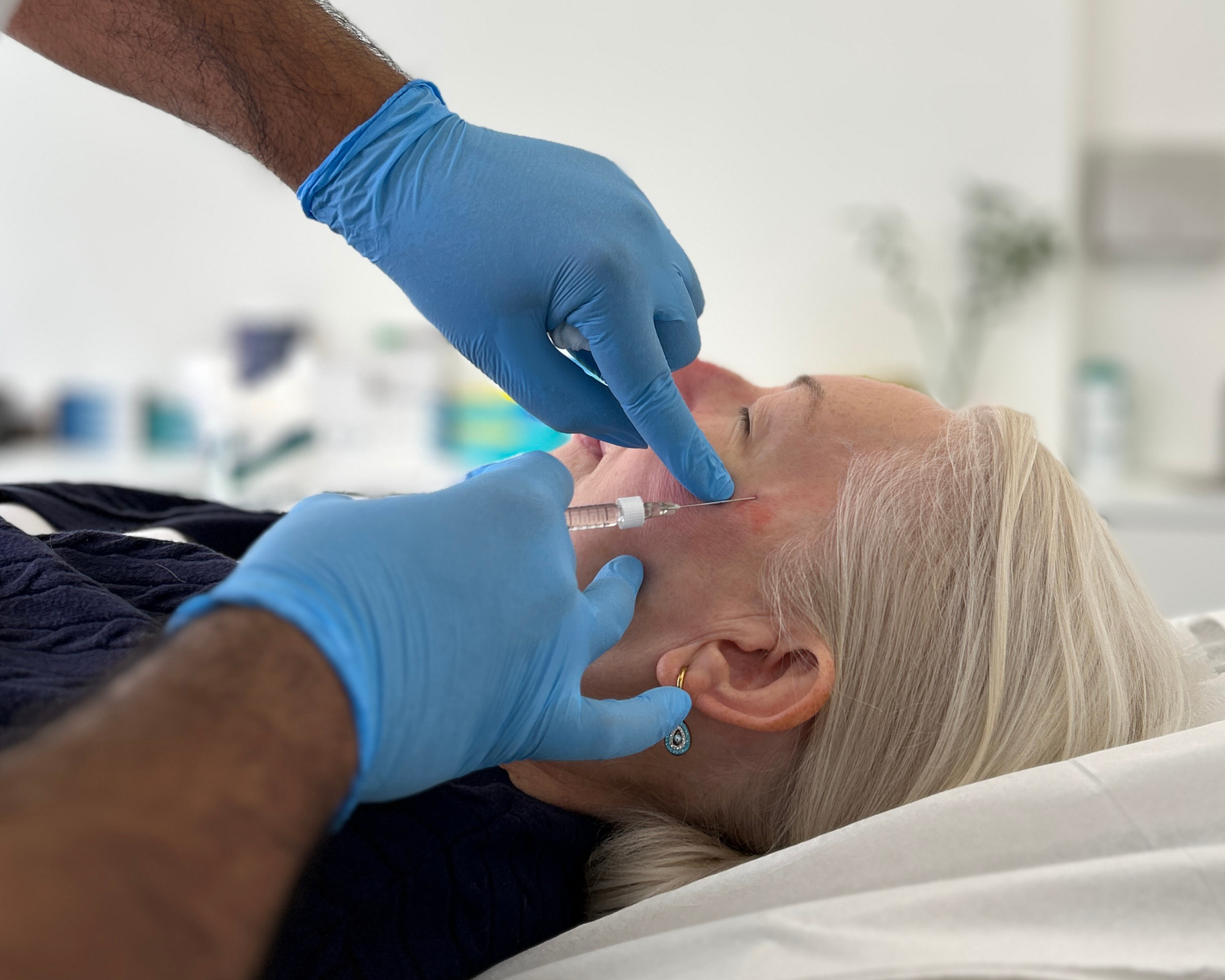
At our Mayfair clinic, every temple filler treatment is carried out personally by Dr Arun Karwal, a GMC registered doctor with a background in emergency medicine. He uses a blunt cannula technique for greater comfort and safety, selects the filler density to suit your anatomy and degree of hollowing, and builds volume conservatively so the result always looks natural. Every treatment begins with a full facial assessment, because the temples are rarely treated in isolation and the best results come from understanding the face as a whole.
FAQs
-
Temple filler is an injectable treatment that uses hyaluronic acid based dermal filler to restore volume lost in the temple region, recreating the smooth, full contour the temples naturally have in a youthful face. Dr Karwal selects a filler density that integrates smoothly with the thin tissue of the temple, providing enough volume to restore the contour without feeling hard or looking unnatural. Hyaluronic acid occurs naturally in the body, is fully biocompatible and temporary, and can be dissolved with hyaluronidase if ever needed.
-
This depends on the degree of volume loss and the result you're looking for. For mild hollowing, around 1ml per side is often sufficient. For moderate hollowing that's affecting the shape and proportions of the face, 1.5 to 2ml per side may be needed, and for more significant volume loss, 2ml or more per side may be appropriate. Dr Karwal will assess your temples during your consultation and recommend the volume that will achieve the most natural, balanced result. It's always possible to take a conservative approach first and add more at a follow up appointment. Building gradually is often the safest and most natural looking approach, particularly if you're new to filler.
-
Most patients find temple filler very comfortable. A local anaesthetic numbs the area throughout the procedure, and the treatment is performed using a blunt cannula rather than a sharp needle, which glides through the tissue rather than piercing it. You'll likely feel some pressure as the filler is placed, and possibly a mild stretching sensation as the volume is built up, but the temple area is generally less sensitive than areas like the lips, and most patients are pleasantly surprised by how manageable it is.
-
The temporal region contains important blood vessels and nerves, so temple filler should only ever be performed by an experienced medical professional with a thorough understanding of facial anatomy. At Karwal Aesthetics, all treatments are carried out by Dr Arun Karwal, a GMC registered doctor. The hyaluronic acid fillers we use are fully reversible, and you'll be given clear guidance on what to expect and when to contact the clinic. Mild swelling, tenderness and occasionally minor bruising in the first few days are normal and resolve on their own.
-
For the first 24 hours, avoid touching or pressing your temples, tight fitting glasses or headbands, intense exercise, alcohol, saunas and extreme heat. Be gentle when washing your face for the first 48 hours, and it's advised to sleep on your back for at least a week to avoid compressing the treated area. For two weeks, avoid facials, facial massage and tight headgear across the temples. If you notice anything unusual such as increasing pain, significant asymmetry, skin discolouration or visual disturbances, contact the clinic immediately. Full guidance is on our aftercare page.
-
Temple hollowing affects virtually everyone to some degree with age, but some people experience it earlier or more noticeably. Those with naturally lean faces and low body fat tend to show it sooner, and significant weight loss often hollows the temples dramatically, sometimes before other areas of the face change. Genetics play a major role, so if hollow temples run in your family there's a reasonable chance you'll develop them too. Endurance athletes and frequent exercisers often show facial volume loss earlier than average, which is a common concern in patients who are physically fit but feel their face doesn't reflect their health. Most people notice some degree of hollowing by their forties.
-
Yes, and it often is. The temples are one part of a wider pattern of facial volume loss, so temple filler can be combined with treatment of the preauricular area, anterior cheek, tear trough, upper eyelid, forehead filler and more, depending on what each individual needs. Dr Karwal will assess your face as a whole at your consultation and recommend whether temple filler alone or a combination will best achieve your goals.
-
You'll find us at 15 Dover Street, London W1S 4LP, in the heart of Mayfair, Central London. We're ideally situated for clients travelling from across London and beyond, with excellent transport links nearby. Book your consultation today.