

Polynucleotides
What are polynucleotides?
Polynucleotides are long chains of nucleotides, the building blocks of DNA. The polynucleotides used in Plinest are derived from salmon DNA, purified to a very high degree, and chosen because they are remarkably biocompatible with human tissue.
Once injected into the skin, they do two things. First, they act as a scaffold that hydrates and supports the tissue. Second, and more importantly, they trigger a regenerative response, stimulating fibroblast activity, encouraging new collagen and elastin production, reducing inflammation and supporting tissue repair. This is why polynucleotides are often described as a regenerative treatment rather than a filler or a skin booster. They do not add volume or replace what has been lost. They improve the quality and behaviour of the skin itself.
What can polynucleotides improve?
Polynucleotide treatment produces a gradual, natural improvement in skin quality rather than a dramatic change. Patients typically see smoother texture and a reduction in fine lines, firmer and more elastic skin, better hydration and a brighter, healthier complexion. Around the eyes, treatment can improve crepiness, fine lines and, in some patients, the appearance of dark circles. Polynucleotides can also help improve the appearance of scarring and are used to support skin quality in areas prone to early ageing such as the neck, décolletage and hands.
Results vary between individuals, and part of the consultation is an honest assessment of what polynucleotides can realistically achieve for your skin, and whether another treatment would serve you better.
Polynucleotides for under the eyes
The under eye area is where polynucleotides have earned most of their reputation, and for good reason. The skin here is the thinnest on the face and the first to show fatigue, crepiness and fine lines. Traditional volumising fillers are often too heavy for this zone, and not every tired eye is a volume problem.
This is where the distinction matters. If the issue under your eyes is a genuine hollow, a trough where volume has been lost, tear trough filler may be the right treatment. If the issue is skin quality, crepey texture, fine lines, dullness and mild darkness, polynucleotides are often the better choice, because they treat the skin itself rather than the space beneath it. Many patients benefit from a considered combination of both, staged appropriately.
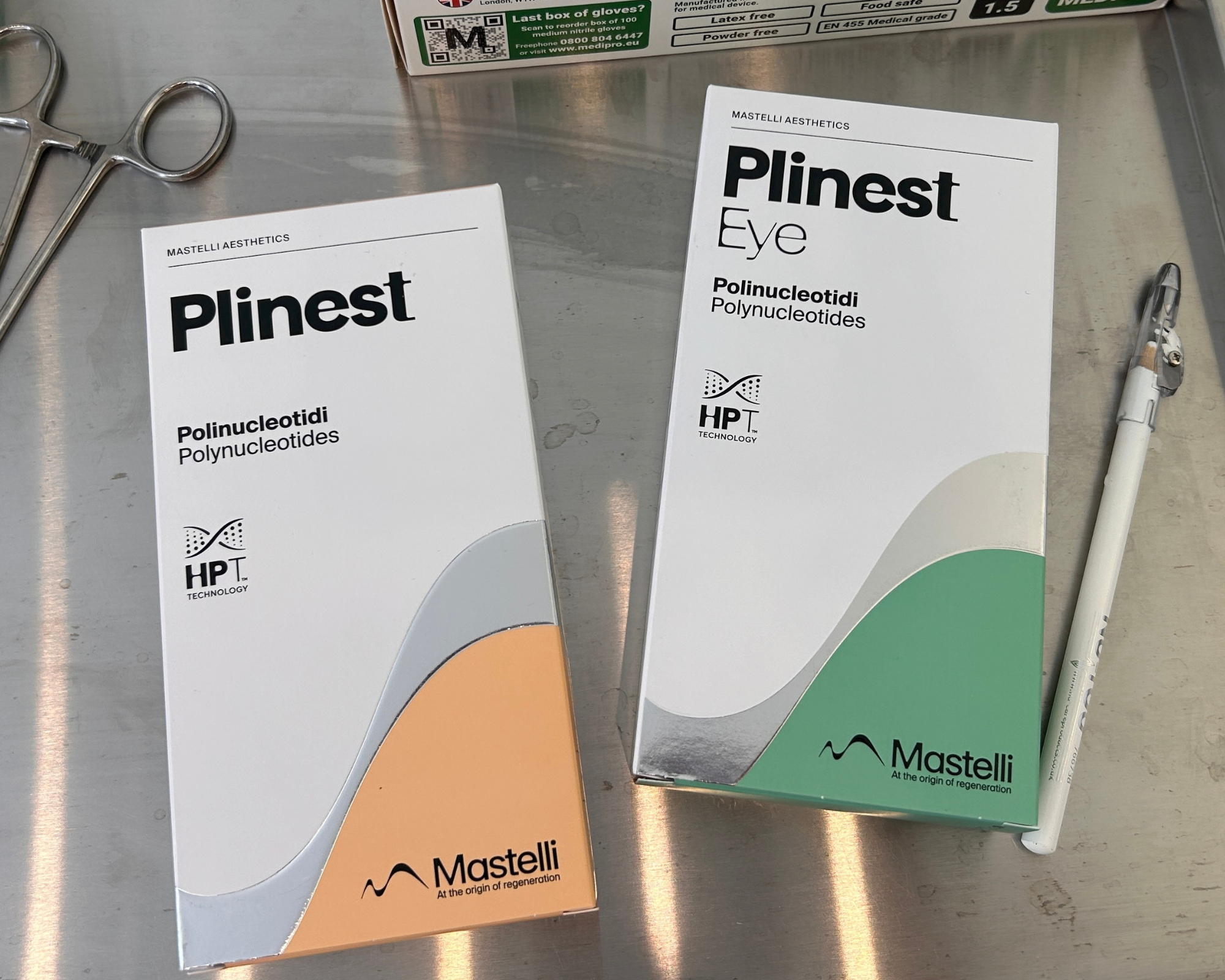
At Karwal Aesthetics we use Plinest Eye, a formulation developed specifically for the delicate periorbital area. Deciding between polynucleotides and tear trough filler is exactly what the consultation with Dr Karwal is for. His assessment takes in your anatomy, your skin quality and any previous treatment, and where filler has been placed in the past, ultrasound assessment allows him to see precisely what is already there before recommending anything new. You can read more about our approach to the under eye area on our tear trough filler page.
Which areas can be treated?
Plinest can be used across the face and body. The most common treatment areas at our clinic are the under eye area and upper face, the mid and lower face for overall skin quality, the neck and décolletage for crepey skin and horizontal lines, and the hands, where thinning skin and visible ageing respond well to regenerative treatment.
Who is suitable, and who is not?
Polynucleotides suit most adults who want to improve skin quality: those with early to moderate signs of ageing, sun damaged or dehydrated skin, tired or crepey under eyes, or those who want to invest in prevention without changing their features.
Just as important is who should not have this treatment, and we would rather you knew before booking. Because Plinest is derived from salmon DNA, it is not suitable for anyone with a fish or seafood allergy. For the same reason it is not suitable for patients who avoid animal derived products, including vegans, though this does not rule out skin quality treatment altogether. Alternatives such as Profhilo and Sunekos are not derived from animal DNA and may be appropriate instead, which Dr Karwal can discuss with you.
Polynucleotide treatment is also not performed during pregnancy or breastfeeding, in line with the guidance that applies to all injectable treatments. Our guide to aesthetic treatments during pregnancy explains this in full. Read here. Treatment is postponed if there is an active infection, cold sore or inflammatory flare at the treatment site, and certain medical conditions and medications may require additional consideration, which is assessed during consultation.
-
£400
-
£700
Our Prices:
FAQs
-
Discomfort is mild. The injections are small and shallow, and numbing cream can be applied beforehand. The under eye area is more sensitive than other zones but remains very tolerable for most patients.
-
Very little. Expect some redness and small bumps at the injection points for twenty four to forty eight hours, and possible bruising for a few days, particularly around the eyes. Most patients return to normal activities the same day.
-
Both improve skin quality, but they work differently. Profhilo uses concentrated hyaluronic acid to hydrate and stimulate collagen and elastin through bio remodelling, and spreads across the treated area. Plinest uses polynucleotides to directly stimulate the skin's repair cells and remains more localised, with additional anti inflammatory benefits. The right choice depends on your skin, your concern and the area being treated, which is assessed during consultation. You can read more on our Profhilo page.
-
Sunekos combines hyaluronic acid with amino acids to provide the building blocks for collagen and elastin, while Plinest uses polynucleotides derived from salmon DNA to stimulate cellular regeneration and repair. Both improve skin quality rather than adding volume. Sunekos delivers strong results across a wide range of concerns, while polynucleotides are recommended where their regenerative and anti inflammatory mechanism offers particular benefit, or where the targeted Plinest Eye formulation suits the under eye area. Dr Karwal will advise which is right for you. You can read more on our Sunekos page.
-
No. Plinest is derived from salmon DNA, so it is unsuitable for anyone with a fish or seafood allergy and for patients who avoid animal derived products. Alternatives such as Profhilo and Sunekos may be appropriate instead.
-
No. Like all injectable treatments, polynucleotides are paused during pregnancy and breastfeeding due to the absence of safety data. Our blog on aesthetic treatments during pregnancy explains what you can and cannot have during this period.
-
They treat different problems. Filler restores lost volume in a true tear trough hollow, while polynucleotides improve the quality of thin, crepey, tired looking skin. Some patients need one, some the other, and some benefit from both.
-
Karwal Aesthetics is a doctor led clinic. Every polynucleotide treatment is planned and performed by Dr Arun Karwal, a GMC registered doctor whose background in emergency medicine underpins a careful, conservative approach to every treatment. We use only prescription grade products sourced from licensed suppliers, and every treatment begins with an unhurried consultation and an honest recommendation, including telling you when polynucleotides are not the right treatment for your concern.
Our clinic is at 15 Dover Street in Mayfair, a short walk from Green Park station on the Jubilee, Piccadilly and Victoria lines, with multiple bus routes serving the area and several car parks nearby.
Appointments are booked online. Book your polynucleotides consultation through our booking page. Click here.
-
Plinest treatments are generally very well tolerated. Because the treatment involves multiple small injections, it is normal to see redness, small raised bumps at the injection points, mild swelling and occasionally bruising, particularly in the delicate under eye area. These effects typically settle within twenty four to forty eight hours, though bruising can take a few days longer. Serious side effects are rare when treatment is performed by a qualified medical practitioner.
For the first twenty four hours after treatment you should avoid touching the treated area, applying makeup, using skincare with active ingredients, alcohol, strenuous exercise, and heat exposure such as hot showers, saunas and steam rooms. Full guidance is provided at your appointment and is available on our aftercare page.
-
Polynucleotide results build over time, which is the nature of a regenerative treatment. Some hydration and a subtle glow may be visible almost immediately. Noticeable improvement in texture and tone typically develops over the first two to four weeks. More significant change appears between four and eight weeks as new collagen production increases, with optimal results usually apparent by three to six months after completing the course.
Results typically last six to twelve months depending on your age, skin condition and lifestyle, which is why a maintenance session every six months or so is generally recommended.
-
Every polynucleotide treatment at Karwal Aesthetics begins with a consultation with Dr Karwal covering your skin concerns, medical history, previous treatments and what you hope to achieve. If polynucleotides are right for you, the treatment itself involves a series of small injections distributed across the treatment area. Numbing cream can be applied beforehand, and the appointment is comfortable and unhurried.
A course of treatment typically involves two to four sessions spaced two to four weeks apart, depending on the area and the condition of your skin, with a maintenance session usually recommended every six months or so to sustain results. Dr Karwal will recommend a protocol for your skin rather than a one size fits all course.