Tear Trough Filler Migration: What It Is, Why It Happens, and How to Fix It
You noticed it gradually, or perhaps all at once. The under-eye area that looked refreshed and rested after your treatment now appears puffy, swollen, or oddly contoured. You may see a ridge forming where the filler has shifted, or a persistent pillow-like fullness that was never there before. You have done your research, and you suspect the filler has moved. You are almost certainly right.
Tear trough filler migration is one of the most commonly encountered complications in aesthetic medicine, and one of the most misunderstood. It is not always the result of a dramatic incident. In many cases, it happens quietly over weeks or months, driven by product choice, injection technique, and the unforgiving anatomy of the periorbital area. At Karwal Aesthetics, we regularly see patients seeking correction of migrated tear trough filler following treatment at other clinics. Understanding why this happens is the first step to knowing what to do about it.
What Is Tear Trough Filler Migration?
Filler migration refers to the movement of injected hyaluronic acid away from its intended placement site. In the tear trough, this typically means product that was placed to restore volume along the orbital rim has shifted into the surrounding tissue, most commonly downward onto the cheek, or forward toward the surface of the skin. The result is a distortion of the natural contour rather than an enhancement of it.
It is worth distinguishing migration from the Tyndall effect, which is a bluish discolouration caused by superficially placed filler visible through thin under-eye skin, though the two can coexist. Migration itself produces visible lumps, ridges, or generalised puffiness, and is often described by patients as a look that has become progressively worse rather than better over time.
Why the Tear Trough Is Particularly High Risk
The periorbital region is arguably the most technically demanding area on the face. The skin beneath the eye is among the thinnest on the body, offering little structural support to hold filler precisely in position. Beneath that delicate skin lies a complex arrangement of ligaments, fat compartments, and muscle that changes significantly with age, weight fluctuation, and general tissue laxity.
The tear trough itself sits at the junction between the lower eyelid and the cheek, an area of constant movement with every blink, smile, and facial expression. There is very little room for error in product placement, and almost no margin for overcorrection. The orbital septum, a fibrous tissue barrier separating the eye socket from the face, weakens with age, and filler placed in the wrong plane or in excessive volumes can migrate through these weakened structures with relative ease.
This is a region where the anatomy varies considerably between individuals, where the same volume of product can produce entirely different results depending on facial structure, skin quality, and age-related tissue changes. That variability is precisely why experience and an in-depth understanding of facial anatomy matter so profoundly here.
The Most Common Causes of Migration
Product selection is one of the most significant factors. Hyaluronic acid fillers vary considerably in their physical properties, and those with high water-attracting capacity can absorb fluid from surrounding tissue and expand beyond their placed volume. When a highly hydrophilic product is injected into the delicate periorbital area, the resulting swelling and positional shift can be considerable, and progressive. This is why the choice of filler for this region is not simply a matter of preference but a clinical decision with direct consequences for the patient.
The depth of injection is equally important. Filler placed too superficially sits close to the skin surface, where it is visible, prone to the Tyndall effect, and more vulnerable to migration with facial movement. Filler placed in the wrong anatomical plane can spread laterally or inferiorly rather than remaining localised to the intended treatment zone.
Volume is the third major variable. The tear trough area requires conservative amounts of product. It is a region that responds poorly to overcorrection, and injecting more than the anatomy can accommodate is a reliable route to a result that looks unnatural, becomes puffy over time, or migrates as the surrounding tissue is unable to maintain the product in position.
Practitioner skill and anatomical knowledge are perhaps the most significant causes of all, and the least often discussed openly. The tear trough is not a forgiving treatment area, and it is not one that should be approached without a thorough understanding of the orbital anatomy, the tissue planes involved, and the way each varies between patients. An injector who lacks that understanding may place product at the wrong depth, misjudge the relationship between the tear trough and the surrounding fat compartments, or fail to recognise when a patient's anatomy makes them a poor candidate for filler in the first place. The use of a sharp needle rather than a blunt cannula in this area also increases the risk of inaccurate product placement and uneven deposition, both of which can contribute to migration over time. The growth of aesthetics as an industry has brought with it a significant rise in under-qualified practitioners offering tear trough treatment, and the periorbital area is consistently overrepresented in complications data as a result. Choosing an injector with a formal medical background and demonstrable experience in this specific region is not a luxury consideration. For an area as anatomically complex and as visually prominent as the under-eye, it is the single most important decision a patient can make.
Finally, repeated top-up treatments without full assessment of existing filler distribution can compound all of the above. Product that has already shifted is unlikely to be corrected by adding more volume, and in many cases doing so will worsen the problem.
How Dr Karwal Approaches the Tear Trough
At Karwal Aesthetics, Dr Karwal's approach to tear trough filler is built around preventing the conditions that lead to migration in the first place. Product selection at our clinic is not a generic decision. Dr Karwal uses Teosyal Redensity 2, recognised within the industry as one of the least hydrophilic fillers available for this indication. Its low water-attracting capacity means it does not expand significantly after placement, reducing the risk of swelling-driven migration and the Tyndall effect that can occur when more hydrophilic products are used beneath thin periorbital skin. This is not a product available at every clinic, and the decision to use it here is a deliberate clinical choice. Injection technique follows the same principle of precision over volume. Dr Karwal takes a conservative approach to the quantity of product placed, working with the individual anatomy of each patient rather than applying a standardised volume. For some patients, correction of a hollow does not require as much product as might initially seem necessary. The relationship between the tear trough and the anterior cheek is also considered carefully. Where additional mid-face support would provide a better long-term foundation for under-eye volume, Dr Karwal will discuss that as part of the treatment plan rather than simply addressing the tear trough in isolation. Every patient undergoes a thorough consultation before treatment, during which the cause of their under-eye concern is identified. Where dark circles are driven primarily by pigmentation rather than volume loss, filler is not the appropriate solution, and alternatives such as Sunekos or prescription skincare are discussed instead. Where skin laxity is a contributing factor, CO2 laser resurfacing may be recommended to tighten and improve the texture of the under-eye skin, and where malar bags are present, Endolift, a minimally invasive laser treatment that targets laxity and fluid accumulation in the lower eyelid and cheek junction, may be the more appropriate solution before or alongside any volumising treatment. A commitment to honest patient assessment of this kind is as important to good outcomes as the technique itself.
Recognising Migration: What to Look For
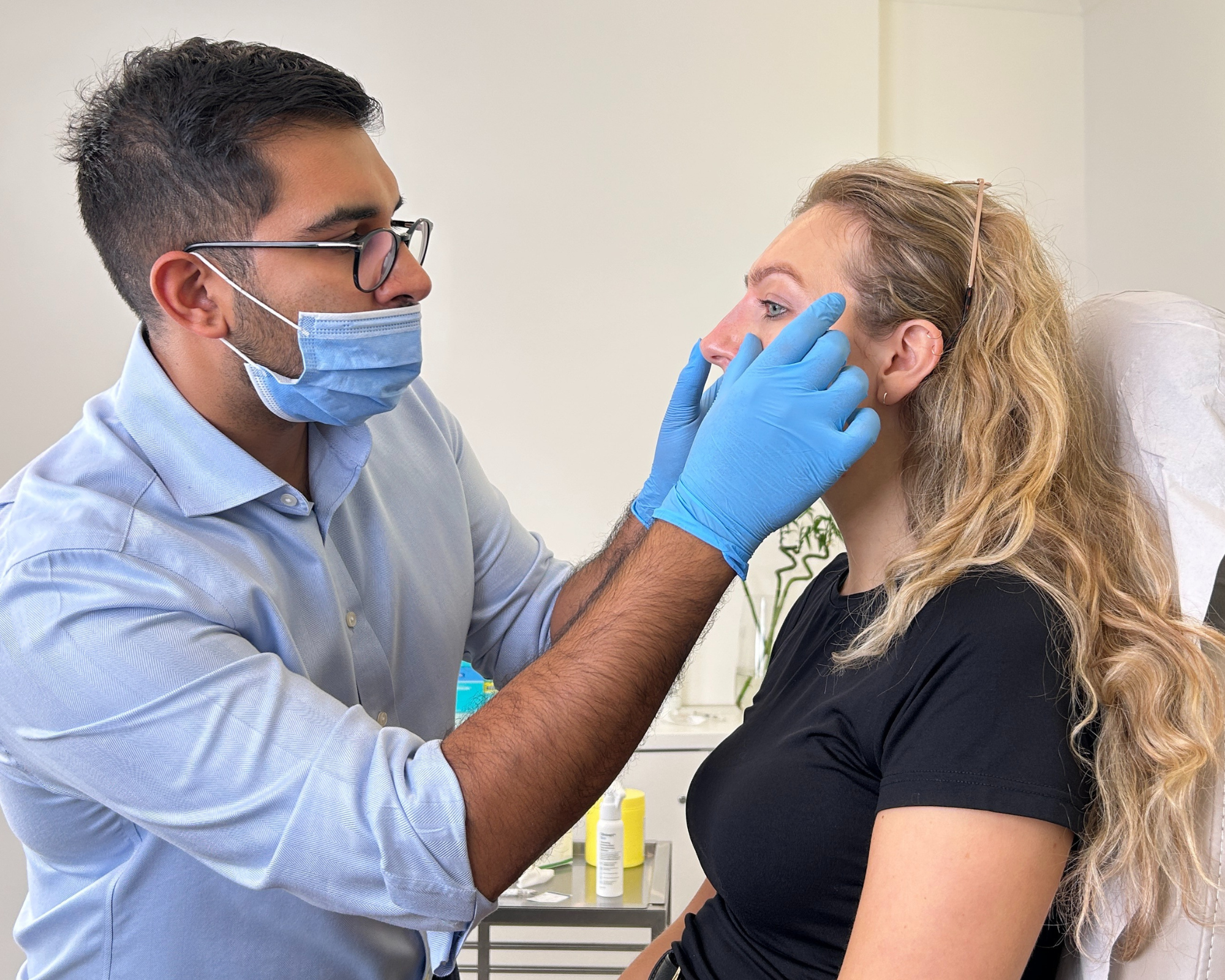
If you have had tear trough filler and are concerned that the result has changed over time, there are several signs that may indicate migration. A pillow-like puffiness beneath the eye that was not present immediately after treatment, particularly if it is more pronounced in the morning or after alcohol consumption, is a common presentation. A visible ridge or line of tissue that follows an unusual path, or fullness that extends lower onto the cheek than expected, may also indicate that product has moved from its original placement. In some cases, asymmetry between the two sides develops or worsens as filler shifts at different rates.
It is important not to confuse normal post-treatment swelling, which resolves within two to four weeks, with longer-term changes that represent genuine migration. If you are more than a month past your treatment and something does not look right, that is worth investigating properly.
How We Correct Migrated Tear Trough Filler
Migrated hyaluronic acid filler can be dissolved using hyaluronidase, an enzyme that breaks down hyaluronic acid. At Karwal Aesthetics, we perform this procedure using ultrasound guidance and cannula-based delivery, a combination that significantly improves both the precision and the safety of the dissolving process.
Ultrasound guidance allows Dr Karwal to visualise the filler in real time before and during the dissolving procedure. This matters because migrated filler is, by definition, not where it was originally placed. Without imaging, the practitioner is working blind, relying on surface assessment alone to estimate product location and distribution. Ultrasound removes that uncertainty, confirming exactly where the hyaluronic acid is sitting, identifying whether product has spread into unexpected areas, and allowing the hyaluronidase to be delivered with precision rather than introduced broadly into the tissue.
Cannula-based delivery of hyaluronidase adds a further layer of control. Rather than using a sharp needle, which introduces a degree of uncertainty in deeper tissue planes and a higher risk of vascular injury, a blunt-tipped cannula can be guided to the precise location of the migrated product identified on ultrasound. This allows targeted treatment with a reduced number of entry points, less trauma to surrounding tissue, and a more even distribution of the dissolving enzyme.
The result is a dissolving procedure that is significantly more accurate than a blind needle-based approach. For patients with complex or long-standing filler distribution, or those who have had multiple previous treatments, this level of precision is not simply preferable. It is often essential.
After Dissolving: What to Expect
Following the dissolving procedure, the tissue will take several weeks to settle fully. There may be some temporary swelling, and in some cases the area will initially appear hollow or uneven as the hyaluronidase works. This is a normal part of the process, not cause for concern. Dr Karwal will advise on realistic expectations for the recovery period based on the quantity and distribution of the dissolved product.
Where a patient wishes to proceed with filler after dissolving, we recommend waiting a minimum of four weeks before any retreatment, allowing the tissue to fully stabilise and return to its natural baseline. At that point, if filler remains appropriate for the patient's anatomy and concerns, the treatment can be approached with complete knowledge of what the natural starting point looks like, and a product and technique chosen to deliver a result that holds.
Considering Tear Trough Filler for the First Time
If you are researching tear trough filler and have not had treatment before, understanding the risk of migration is part of making an informed decision. It is not a reason to avoid the treatment, which, in the right hands with the right product, can produce results that are genuinely transformative for the under-eye area. It is, however, a reason to choose carefully.
Questions worth asking any prospective injector include what product they use and why, how they approach volume decisions, and what their process would be if dissolution were ever required. A practitioner who can answer those questions clearly, and who is willing to recommend an alternative approach if filler is not appropriate for your anatomy, is one whose clinical priorities are likely to be aligned with your long-term results.
Book a Consultation at Karwal Aesthetics
Whether you are managing the effects of a previous tear trough treatment or considering the procedure for the first time, Dr Karwal offers thorough, unhurried consultations at our London Mayfair clinic at 15 Dover Street, W1S 4LP. Assessments are honest, recommendations are individualised, and where correction is required, our ultrasound-guided dissolving service is available to address migrated filler with the precision that this delicate area demands. Book online at karwalaesthetics.com.
For more information on the tear trough filler treatment click here. To see our full tear trough filler before and after portfolio, click here.