Restore Your Ear Lobes
The problem most people don't talk about
There is a particular frustration in reaching for a favourite pair of earrings and noticing your ear lobes no longer look the way they used to. The piercing has stretched, so the earring sits awkwardly. The lobe looks thin, creased, or elongated against an otherwise well-preserved face. Maybe you've noticed your hair hanging down more often lately, almost unconsciously covering them. Or you simply find yourself choosing earrings differently—avoiding the dangling styles you love, opting instead for studs that feel safer, less noticeable.
Many patients come to us quietly disappointed about this. They've invested in their appearance, maintained their skin, addressed lines and volume loss elsewhere on the face. But somehow, a feature they never thought about until it changed has become impossible to ignore. The injustice of it is partly what brings people in: ear lobe ageing seems disproportionate, happening faster than the rest of the face, and it feels unfair that something so small can affect how you feel about yourself.
Ear lobe ageing is one of the most common and least discussed concerns in aesthetic medicine. It is also one of the most treatable. Ear lobe filler is a precise, low-downtime treatment that restores volume to thinning or stretched lobes, improves how earrings sit, and delivers a genuinely rejuvenating result in minutes. At Karwal Aesthetics in Mayfair, Dr Arun Karwal performs it with the same anatomical precision and conservative approach that guides every treatment at the clinic.
Why ear lobes age so visibly
The lobe is almost entirely soft tissue, a small pad of fat, connective fibres, and skin without the cartilage that supports the rest of the ear. From the mid-thirties onwards, declining collagen and elastin cause the lobe to flatten, elongate, and develop fine creasing. This process is visible because the lobe is small and the changes are therefore proportionally large.
The biggest accelerator is mechanical stress from earrings. Years of heavy hoops and long drops gradually stretch the piercing and pull the lobe downward. Over time, this repeated stress can flatten the natural padding under the piercing hole, making the hole appear larger or the surrounding tissue less defined. Very heavy jewellery worn daily can amplify this effect significantly. Genetics play a part too—some people's skin loses elasticity faster than others, and some naturally have thinner lobes. Unprotected sun exposure contributes as well, as UV damage breaks down collagen and elastin throughout the skin, including in the ears, an area many people forget to protect.
The result is an area that often ages disproportionately, looking noticeably older than the rest of a well-maintained face, particularly when earrings are worn or the hair is pulled back. For people who love jewellery, this can feel especially unfair.
Why people choose to treat it
Patients seek ear lobe filler for a range of reasons, and understanding what drives that choice helps explain why this simple treatment can have such a meaningful impact.
Restoring confidence around jewellery. Some people feel they can no longer wear the styles they love. Dangling earrings that once sat beautifully now pull at an elongated lobe. Statement pieces that were part of their identity now feel self-conscious to wear. The psychological shift—from choosing jewellery you adore to choosing what feels least noticeable—is real and affects how people feel day to day. Treatment allows them to return to their preferred aesthetic without reservation.
Looking proportionate again. A well-maintained face with volume loss in the lobes creates visual discord. You might have addressed nasolabial lines, restored cheek volume, and treated other signs of ageing, yet a stretched or thin lobe undermines the overall result. Patients describe it as a final piece of the puzzle—the detail that, once restored, allows the whole picture to feel cohesive and intentional again.
The freedom to wear their hair as they choose. Several patients mention that they've started wearing their hair down more often, almost without realising it, to cover their ears. Once lobes are restored, this shifts. Pulling hair back, wearing it up, or choosing styles based on preference rather than concealment feels like a small freedom but matters more than it sounds.
Visible but discreet improvement. Ear lobe filler is one of the few treatments that delivers meaningful aesthetic improvement whilst remaining almost entirely private. No one you pass on the street will know you've had it done. But you will know, and the people closest to you will notice that you look fresher, more vibrant, and more like yourself.
Age is no longer the story of that one area. Ageing happens everywhere, but when it happens noticeably in one small, very visible area—and that area is often on display when you wear jewellery or pull your hair back—it can become the focus. People describe treating their lobes as reclaiming their narrative; the lobe is no longer the oldest-looking part of their face.
What the treatment actually does
Ear lobe filler involves placing a small amount of hyaluronic acid dermal filler into the soft tissue of the lobe. Hyaluronic acid is a naturally occurring substance that binds water and restores hydration, volume, and structural support to tissues. Placed precisely, it restores the rounded contour that defines a youthful lobe.
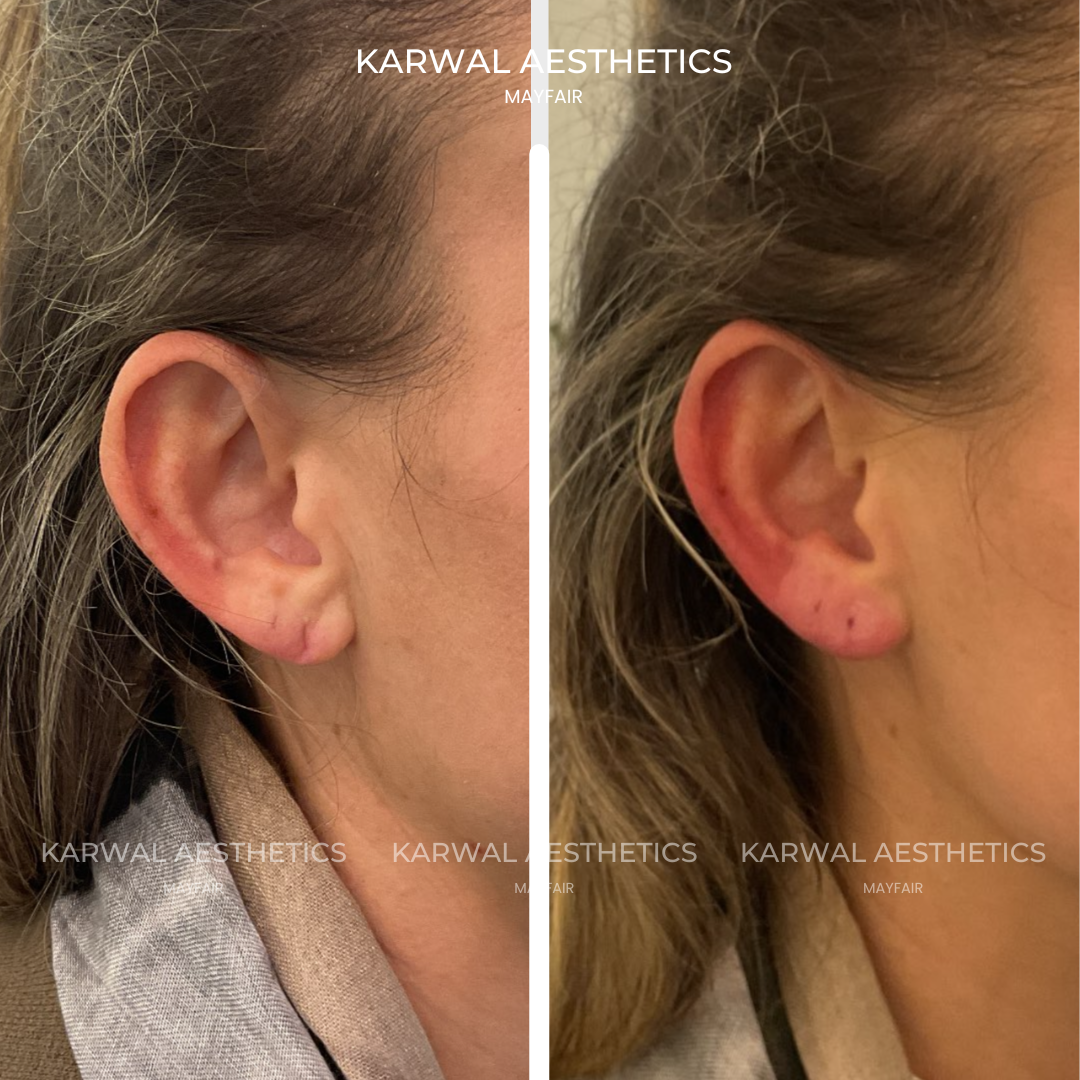
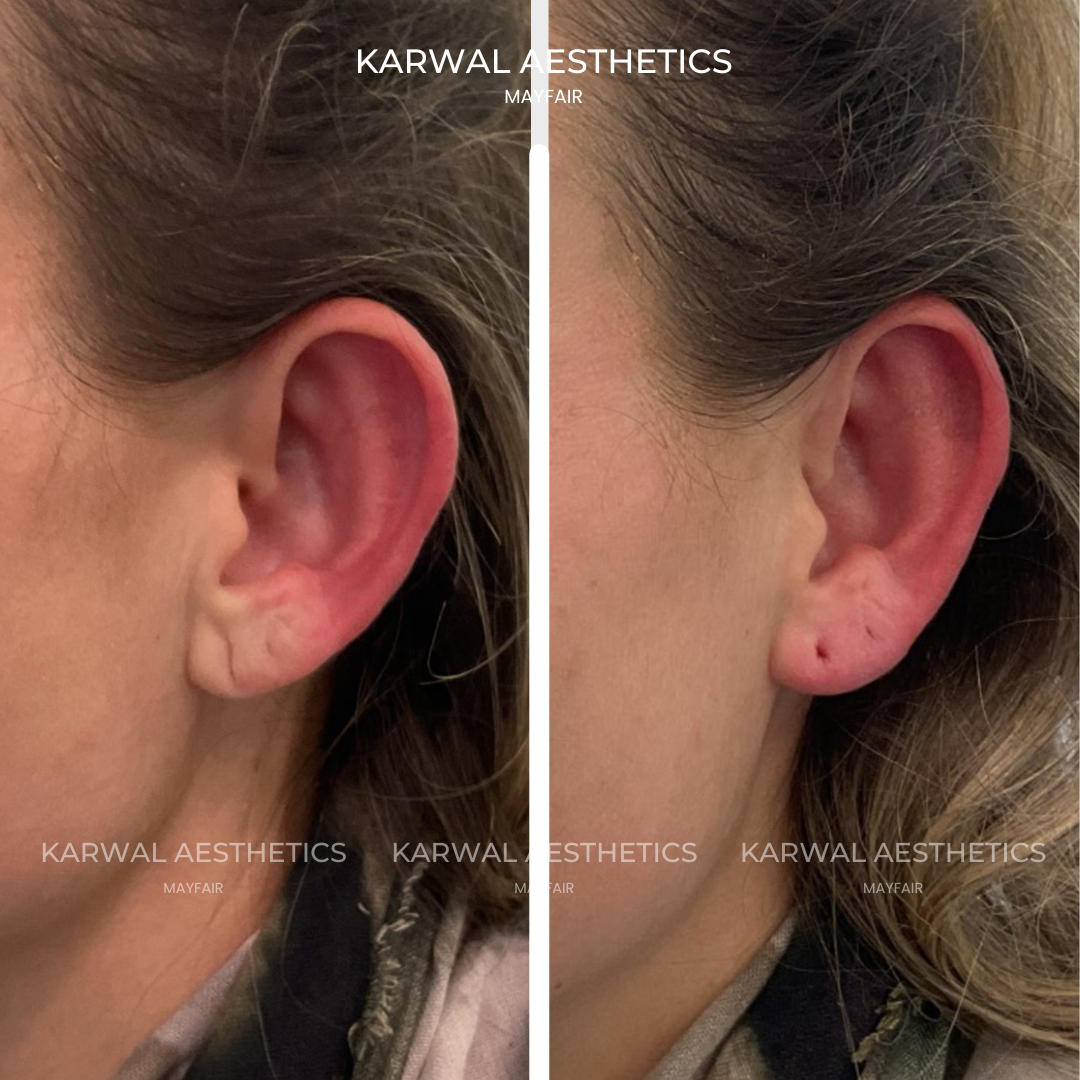
More specifically, filler lifts a drooping lobe by providing structural support where collagen and elastin have thinned. It fills flattened tissue beneath the piercing, which both makes the piercing hole appear smaller or more naturally proportioned and restores the three-dimensional shape of the lobe. It softens fine creasing and the lined appearance that develops on thin lobes. It rebuilds the cushioning around a stretched piercing so earrings sit more naturally and don't pull or strain the area further.
Importantly, the goal is not to make the lobe bigger. The lobe is small, and making it larger would look artificial and unnatural. The goal is restoration—putting back what time has taken away so the lobe regains its youthful shape, proportion, and the way it frames the ear.
The filler used at Karwal Aesthetics is a prescription-grade, UK-licensed hyaluronic acid product, sourced from licensed suppliers and direct manufacturers. It is administered by Dr Karwal as part of a treatment plan that prioritises natural-looking results and long-term safety.
Who it suits and who it doesn't
Ear lobe filler works well for patients experiencing volume loss and flattening, elongation and drooping, stretched or enlarged piercing holes, fine creasing on the lower lobe, and asymmetry between the two sides. It is also popular before significant occasions where statement earrings will be worn, for patients who want to feel confident again with jewellery they love.
It is not appropriate if the piercing is currently infected or inflamed, if there is active skin disease in the area, or if the lobe has torn through entirely. Complete splits or significant gauging are surgical concerns rather than injectable ones; the tissue integrity has been compromised and filler cannot restore that. Where the lobe is split or significantly gauged, surgical repair is the right route, and Dr Karwal will tell you so honestly rather than suggest filler can resolve something it cannot.
If you have stretched lobes from gauging but the tissue is still intact, filler can still improve the appearance and provide some lift, though the results may be more subtle than in someone with straightforward volume loss.
The procedure in detail
Before the appointment, you should avoid blood thinners like aspirin, ibuprofen, and high-dose vitamin E for 48 hours beforehand, as these increase bruising risk. A topical anaesthetic cream is applied to the lobes 20 to 30 minutes before the treatment begins, and most patients find the injections very tolerable. Some describe a slight pressure sensation rather than pain.
The volume needed is small, typically under 0.5ml per lobe and often considerably less (sometimes as little as 0.3ml per side). Using a fine needle or cannula, Dr Karwal distributes the filler precisely where volume has been lost, treating and assessing both lobes together for perfect symmetry. He works conservatively, layering the product carefully to build volume gradually and maintain a natural contour. Overtreatment would look immediately obvious in such a small area, so precision is essential.
The whole appointment takes 15 to 30 minutes. There are no incisions, no stitches, and no downtime in the traditional sense. Patients are ready to leave straight after treatment, though it is sensible to wait at least 24 hours before putting earrings back in. For the first few days, avoid heavy earrings, tight hair styles that pull on the lobes, and swimming, as chlorine and salt water can irritate newly treated skin.
Mild swelling or tenderness for the first day or two is normal. The swelling is usually very subtle and often unnoticeable to anyone but you. Minor bruising near the piercing can occasionally occur, particularly if a needle was used rather than a blunt cannula, and it will fade within a week.
The result should look natural and proportionate—fuller without looking treated. When done well, people notice you look fresher and more vibrant, but they don't see the filler itself.
How long it lasts
Results typically last 12 to 18 months, and often considerably longer, because the lobe is a low-movement area subject to less mechanical breakdown than higher-movement facial areas. There is very little facial expression in the lobes, unlike the mouth, eyes, or forehead, so the filler is not constantly being compressed and reabsorbed by muscle movement.
Longevity depends on several factors: the product used, the volume placed, your individual metabolism (some people metabolise hyaluronic acid more slowly), whether you return to wearing very heavy jewellery (which will reassert mechanical stress over time), and your genetics. Someone who goes back to wearing heavy hoops daily may notice the results softening sooner than someone who switches to lighter styles.
Hyaluronic acid is reversible, so in the rare event correction is needed the filler can be dissolved with hyaluronidase. Ultrasound-guided dissolving is available at Karwal Aesthetics where appropriate, allowing for precise correction of any unevenness or over-treatment.
Safety and side effects
Ear lobe filler carries a lower risk profile than many facial areas because the lobe has no major blood vessels of the kind that raise concern in sensitive areas like the nose, temples, tear troughs, or lips. There are no major nerves in the lobe either, which is why the sensation is usually minimal and complications extremely rare.
The most common side effects are temporary swelling, tenderness, and bruising, all of which settle within a few days to a week. Swelling is usually mild—most people don't notice it unless they're looking very closely. Bruising, when it occurs, is minor and easily covered by hair or conventional concealer. Infection is vanishingly rare with sterile technique, and allergic reactions to hyaluronic acid filler are extremely uncommon, as hyaluronic acid is a substance your body already produces.
Dr Karwal's background in emergency medicine informs how he assesses, prevents, and manages complications. He prioritises technique, conservative placement, and thorough aftercare advice to minimise any risk.
Book your consultation
If you have been wearing your hair down to hide your ear lobes, have set aside earrings you love because your lobes no longer look the way they should, or feel that your lobes no longer match the effort you've put into your overall appearance, ear lobe filler may be exactly what you have been looking for.
Book a consultation with Dr Karwal at karwalaesthetics.com. Read more about the treatment here.